Start the Toolbox Path
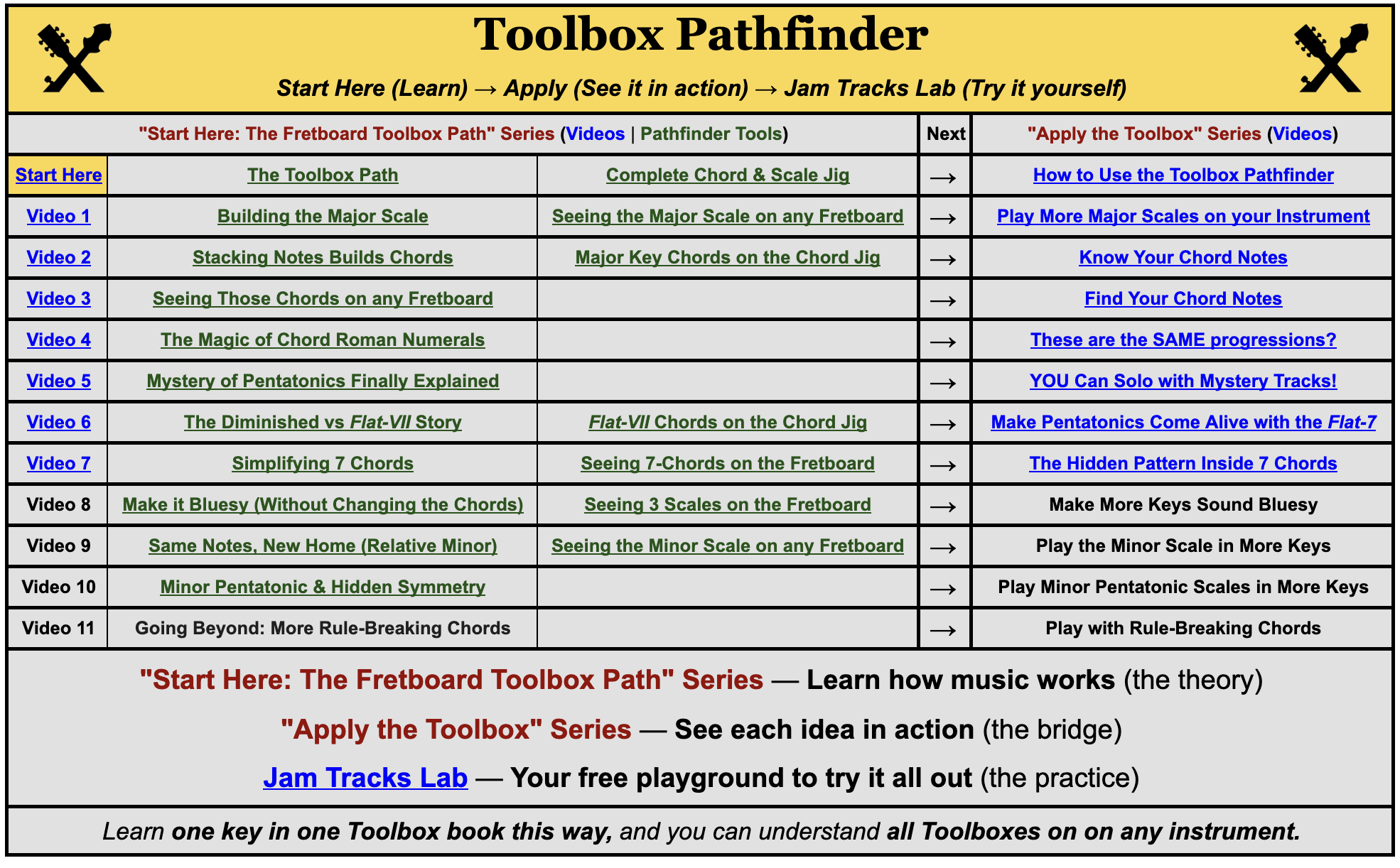
Using Fretboard Toolboxes to unlock the freedom that comes from understanding music theory involves three steps:
Watch each “Start Here: The Fretboard Toolbox Path” video. (this is the theory)
Then watch each corresponding “Apply the Toolbox” video. (this is the bridge)
Then go to the free Jam Tracks Lab to experiment with what you learned. (this is the practice)
Open free Fretboard Toolbox tools in Google Sheets (Recommended)
- Best layout and functionality
Download for Excel
- May require minor adjustments depending on your version
Who are Fretboard Toolboxes made for?
If you’re like me and have spent serious time lost in a web of ideas that music instructors talk about all the time- chord tones, scales, keys, chord Roman numerals, triads, pentatonic scales, blues notes, etc., then know that you’re not alone!
For years my musical “understanding” was a series of random songs I’d memorized the chords to mixed with seemingly random, disconnected chord and scales shapes. I could “put my fingers there”, but nothing past that. To move from copying to creating and communicating with music, I needed a way to see the connections.
Being a person who is lost without the big picture is what led me to create Fretboard Toolboxes. Toolboxes aren’t more charts to memorize- they’re tools to let you see how music is a logical system of keys that you can understand and predict.
Fretboard Toolboxes let you see all these ideas, but there’s a learning curve.
And that’s why I built the Toolbox Path.
The Toolbox Path
Step 1. Learn the Major scale and discover all the doors it unlocks.
• The seven notes that belong to the key are the foundation of everything.
• Once you truly understand the Major scale, the rest of music starts making sense.
Step 2. See how the chords of a key come straight from those notes.
• Each key has six main chords that come straight from the seven notes of the Major scale.
• They literally come from stacking every other note of the scale.
Step 3. Learn the notes that make up those chords, and find them on your instrument.
• Knowing the notes and their locations lets you see that chords aren't random shapes.
• The same notes make up the same chords —on every instrument!
Step 4. Practice common chord progressions and learn their Roman numerals.
• Knowing the Roman numerals changes how you hear music, and lets you play songs in any key.
• The more you play progressions in a key, the more predictable songs become.
• This is where keys, scales, chords, and your instrument start connecting.
Step 5. Discover the hidden connections in pentatonic scales.
• Both Major and minor pentatonic scales have game-changing secrets hidden inside them.
• Without understanding these connections, pentatonic scales may often leave you wanting more.
Step 6. Unlock the secrets to bluesy sounds in Major keys.
• That tension is the heart of blues, bluegrass, and bluesy-rock.
• But changing the home note changes everything, and suddenly the music feels darker.
• Those bluesy notes also explain 7 chords, and why Toolboxes show the flat-7 (bVII) chord.
Step 7. Open up a new world of sounds with natural minor keys.
• Certain minor scale notes create really cool tension against Major chords.
• If you know the Major scale, then you already know the natural minor!
• Experiment with them in the Jam Tracks Lab to start hearing and feeling the connections.
Step 8. Explore Rule-Breaking Chords (and how to use them)
• Tons of songs use chords from outside of the key
• Chords like Major II, Major III, minor iv, and VI add lots of flavor.
• These same ideas show up everywhere — from rock, country, jazz, pop, and many more!
— At this point, you’re not guessing anymore.
— You’re finding patterns and connections every time you play.
— You’re moving from “copy” to create and communicate.
• If the song feels straight ahead → experiment with Steps 1–4.
• If the whole song sounds darker, try ideas from Step 5.
• If it feels bluesy, try ideas from Step 6.
So put your music on shuffle, and start figuring out keys, chords, melodies & solos!
Practice With Jam Tracks
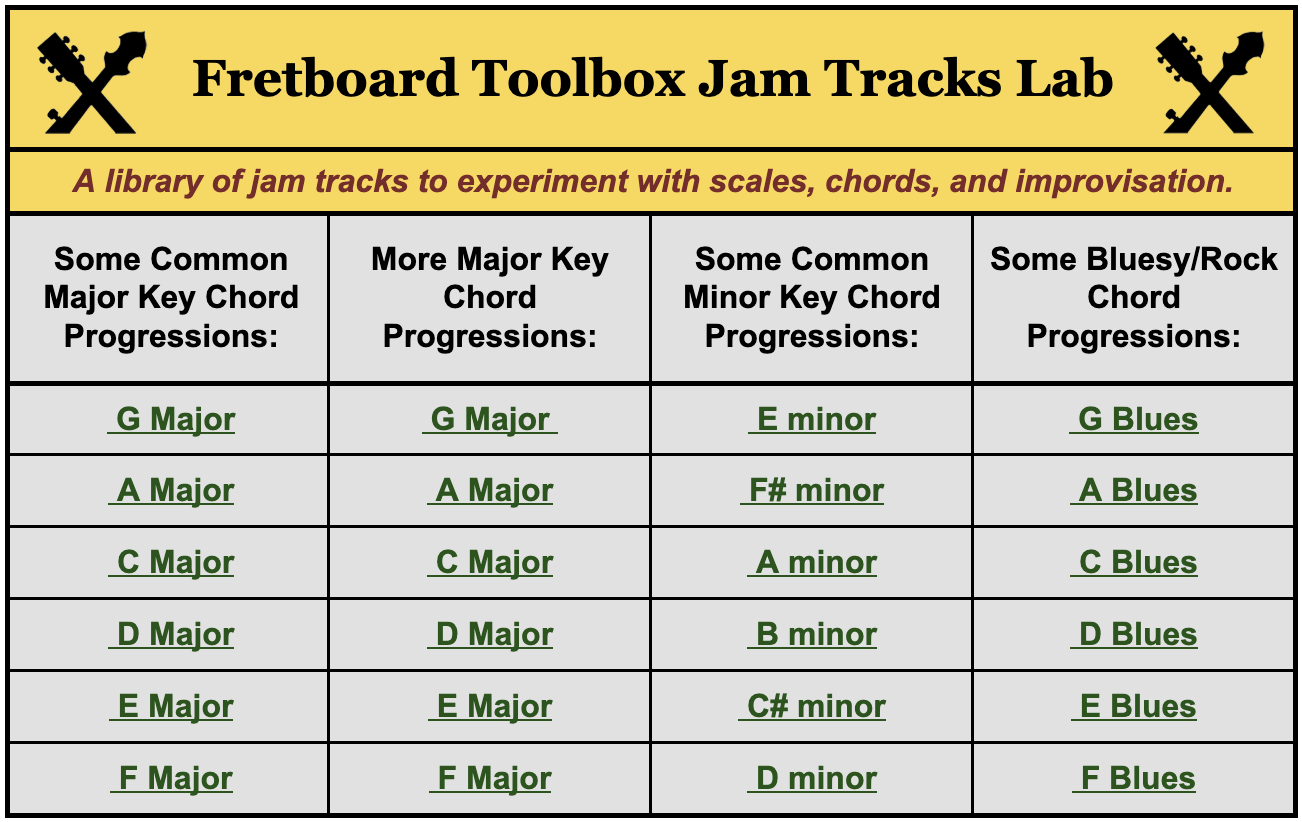
The Jam Tracks Lab lets you experiment with chord progressions, scales, and keys, at your own pace.
Check out the Toolbox Video Library
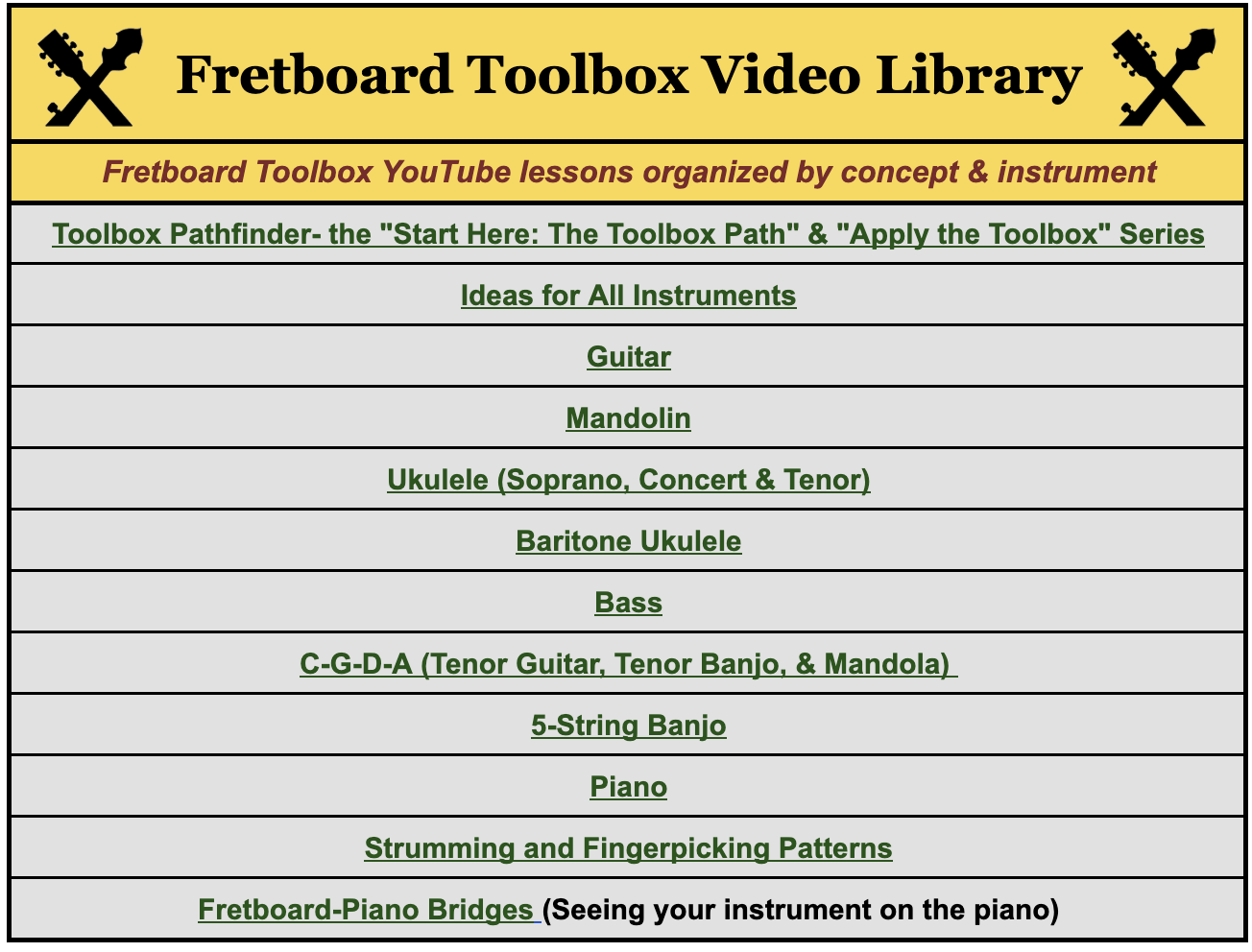
The Video Library has over 200 Fretboard Toolbox YouTube videos spanning over 15 years!